The Space, titled “Youth, Jobs, Accountability & Good Governance,” drew more than 48,000 live listeners, pushing #NDCBuriedTheYouth to the No.1 spot on Ghana X.
What followed was a three-hour avalanche of anger, frustration, and raw testimonies from young Ghanaians watching their futures collapse in slow motion.
“Students can’t pay fees — the promises were empty.”
Abigail Iddrisu (@BillionaireAi25) didn’t mince words:
“Students admitted to university are still waiting for the government to pay fees promised in the manifesto. Nothing. How do they survive?”
“National Service postings rejected — unless you know somebody.”
Nat G. Tetteh (@NatGTetteh) dropped a bomb:
“State agencies are rejecting National Service postings. If you don’t have connections, forget it. This is pushing young graduates into despair.”
“2024 promises have turned into 2025 suffering.”
Akosua NPP Warrior:
“They promised heaven in 2024. They have delivered hell in 2025. The youth are wide awake. 2028 is payback time.”
Leaked memo triggers political earthquake
A leaked Finance Ministry memo ordering sharp cuts to revived NABCO jobs sent the Space into chaos.
Meanwhile:
- Free SHS feeding grants are 11 months in arrears
- nursing and teacher allowances are still “under review”
The question repeatedly asked: “What exactly is working for the youth?”
“Every lie will be replayed until 2028.”
In a fiery closing statement, NPP Loyal Ladies Director for Diaspora Affairs Ms Karen Kemetse declared a full political offensive:
“Every lie will be replayed in every village until 2028. The youth have been betrayed — but they will have the last laugh.”
She announced weekly Monday-night exposés leading up to the 2028 elections.
Analysts: the youth vote is slipping fast
Political watchers warn the NDC may be losing grip on the very demographic that secured victory in 2024. Some analysts describe the youth vote as being “on emergency life support.”
Ghana’s political temperature is boiling. And tonight’s Space made one thing clear: the 2028 countdown has already begun.
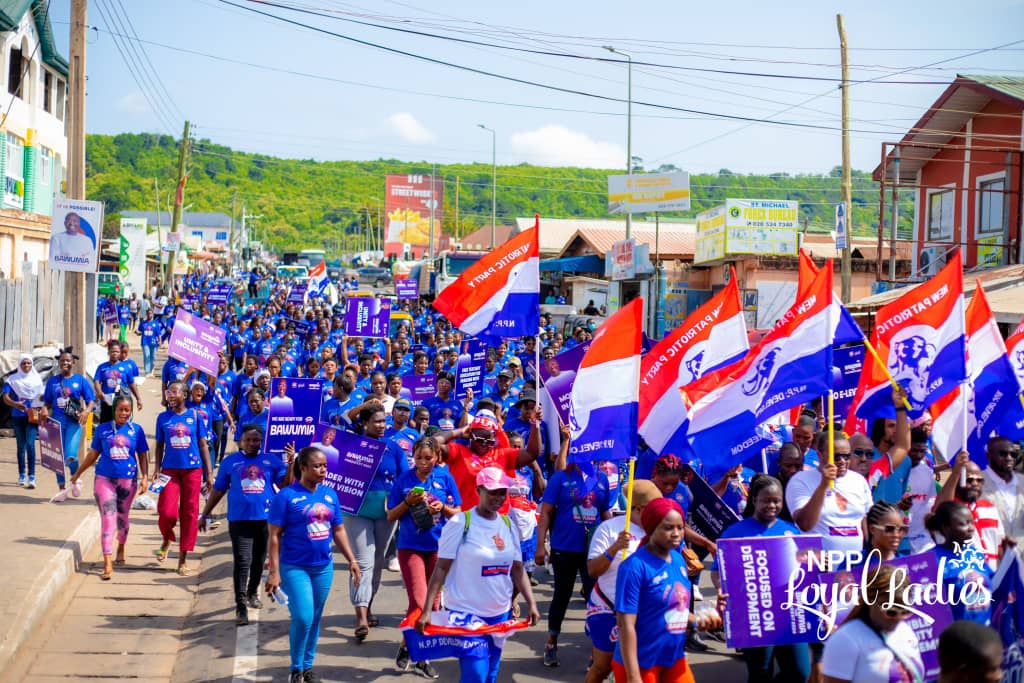
Accra, December 8, 2025 — GhanaSpeak News Desk
A major political controversy has erupted after a representative of the Office of the Special Prosecutor (OSP) appeared to confirm the existence of a WhatsApp group that includes senior journalists, civil society actors, and officials from state accountability institutions.
The comment, made during a live interview on JoyNews’ Newsfile, suggested the group includes the Auditor-General and even representatives of the Supreme Court.
The OSP official’s remark came during a discussion on corruption and ethical reform. When asked by journalist Manasseh Azure Awuni about coordination between the OSP and government actors, the official replied, “There is a government WhatsApp group that we are on… to chart a new path on ethics and corruption policy.”
He later attempted to clarify the point, insisting the group was “not influenced” by government direction.
Social media reaction was immediate. The hashtag #Abanfooaba trended within hours, with many users questioning why journalists and oversight institutions would be part of a group apparently coordinated by the ruling administration. The timing also added fuel to the controversy, with the comment occurring on the first anniversary of President John Mahama’s 2024 election victory.
Opposition figures quickly moved to frame the development as evidence of political interference. In a Twitter Space hosted hours later, contributors described the group as a “narrative-shaping circle” protecting government interests at a time of increasing economic pressure and complaints of rising unemployment.
Franklin Cudjoe of IMANI Africa distanced himself from the group, stating that no member of his organization was part of the chat, and raised concerns that such a platform could be used to influence accountability processes.
Unconfirmed reports circulating online suggest that the original WhatsApp group was dissolved shortly after the backlash and replaced with a new one.
The Presidency is yet to issue an official response.
Ghana continues to face questions over youth joblessness and slow progress on the promised 24-hour economy. Opposition figures say the current scandal only reinforces fears that key state institutions are compromised.
GhanaSpeak.com will continue monitoring this developing story.
]]>
Education is the heartbeat of Ghana’s future. It is the single most important investment in our youth, shaping whether they rise to global competitiveness or remain trapped in cycles of mediocrity. Over the past two decades, Ghana’s education system has been defined by two contrasting traditions: the New Patriotic Party (NPP), which has consistently expanded access and improved outcomes, and the National Democratic Congress (NDC), which has repeatedly reversed progress, leaving behind systemic failures.
Kufuor’s Vision: The Four-Year Senior High School
President John Agyekum Kufuor’s administration introduced the four-year Senior High School (SHS) system, a bold reform that gave students more time to absorb content and prepare for WAEC examinations.
- WAEC pass rates improved during the four-year cycle.
- Teachers reported reduced pressure and better preparedness among students.
- More students qualified for tertiary education, strengthening Ghana’s human capital base.
This was a reform rooted in foresight, prioritizing the long-term success of Ghanaian youth.
Mahama’s Reversal: Back to Three Years
President John Mahama’s government scrapped the four-year SHS, reverting to three years. The decision was driven more by political expediency than educational logic.
- Students were rushed through syllabi.
- WAEC failures increased, particularly in core subjects.
- Teachers expressed frustration at the collapse of standards.
Recent WAEC statistics underline the damage: in 2025, Core Mathematics pass rates dropped from 66.86% in 2024 to just 48.73%, while English fell from 66.98% to 56.76. These declines are not abstract numbers, they represent thousands of young lives disadvantaged by poor policy choices.
Akufo-Addo’s Free SHS and Teacher Allowances
President Nana Akufo-Addo’s Free SHS policy, launched in 2017, was a landmark reform. For the first time, financial barriers were removed, allowing every child to access secondary education.
- Over 5.7 million students have benefited since its inception.
- Enrollment surged nationwide, bridging the gap between rich and poor.
- Gender parity improved, giving girls equal opportunities in education.
Akufo-Addo also restored teacher trainee allowances, boosting morale and attracting more young people into the teaching profession. Motivated teachers translate into stronger classrooms and better student outcomes.
Mahama’s Attack on Teachers
Mahama’s government scrapped teacher trainee allowances, claiming fiscal unsustainability.
- Teacher morale collapsed.
- Fewer young people pursued teaching careers.
- Classrooms suffered from shortages and declining quality.
The correlation is undeniable: demoralized teachers + underprepared students = mass WAEC failures.
The Brutal Truth
The evidence is clear:
- NPP reforms (Kufuor’s four-year SHS, Akufo-Addo’s Free SHS and teacher allowances) expanded access, improved outcomes, and motivated teachers.
- NDC reversals under Mahama destroyed progress, fueled exam failures, and crippled Ghana’s education system.
Mahama’s tenure represents a dark chapter in Ghana’s education history. His policies prioritized politics over pedagogy, leaving Ghanaian youth disadvantaged in global competitiveness.
Final Word
If Ghana is serious about building a future of excellence, it must reject the destructive reversals of the NDC and protect the visionary reforms of the NPP. Education is not a playground for political experimentsit is the lifeline of our nation.

I wanted to get a new SIM to complement the one I already have. Then I decided to patronise a road side sim vendor and the unexpected happened.
During registration, I gave out the needed details to the vendor and the registration was going on smoothly until it got to capturing.
Usually, you are expected to be captured once but the vendor captured me twice and that made me suspicious. So I queried him but he gave a flimsy excuse.
Immediately after the registration, I got a welcome text message indicating I registered two numbers instead of one
I asked why two numbers registered in my name instead of one, the vendor said “it’s normal, that sometimes the issue is from the network operators”.
The next day, I went to Glo office to lay a complain and the moment I mentioned what brought me, the manager there said
“these guys again? Why doing these to innocent people”?, that was when I realized the gravity of what just happened. The second number was deregistered, the case was reported and the guy was picked up.
Questioning the vendor, he said they usually use people’s details to register other sim cards which they resell to “car trackers” at a higher price.
On further interrogation, he confessed that he uses people’s details to register sim cards which they sell to fraudsters, ritualists, kidnappers and he makes a lot of money from the business.
Now, imagine if he sold this second number to a kidnapper or a fraudster and when tracked, my picture and details would pop up and it would be difficult to deny.
I’m putting this out here because a lot of innocent people are in prisons today because of cr!me they know nothing about.
While doing your registration, please be attentive and report any suspicion to the right authority.
Thanks Let’s Be Guided Please.
]]>
I really admire the President and the NPP’s commitment to making secondary education free for all, and not be a hindrance for the poor or deprived. THIS IS SUPER GOOD.
But surely, we should run our free education in a way that helps the young people, the state and the economy as a whole. Whilst lauding the opportunity for all to have secondary education, the few years of implementation points to several practical challenges – stifling the economy, collapsing private schools and businesses and creating lots of hiccups in the smoothness we’ve known with our secondary education. And this is why it surprises when the Government consistently insists on not ‘reviewing Free SHS’.
Let me say, I pity the government for getting a bad name for what it does out of good intentions for the people of Ghana.
But the sure fact is that good thought isn’t all that it takes to satisfy a people and prosper a nation. The good thought must be carried through a strategy of pragmatism, truthfulness and objectivity; otherwise this good intention would give the NPP more bad name – and I could predict that many parents who enjoyed the freedom from payments, and even the students who went through this free education, would vote against the NPP one day soon.
And this is simply because, we asked our governments to get our children opportunity to experience secondary education. We never really asked them to give our children food for free! If they choose to do so, they may, but must do it effectively – not compromise the training and knowledge we asked for!
It’s surely best to give all qualified Ghanaians a chance to secondary education, but should free education mean ‘FREE FEEDING’? In the countries that we are often proud to mention as successful education and economies, FEEDING IS NEVER FREE.
Rather, every opportunity is availed for qualified young persons
• to have admission into schools
• to have a good, reliable and consistent academic calendar
• to have the best of all the needed facilities for teaching and learning generally for free
with teachers and other staff who are well motivated to teach and guide the students to learn.
As know it now, Free SHS is a veritable yoke around the neck of government, the economy, parents, the GES, teachers, and the students themselves. The promise we hear is that an improved economy would help deliver a better free SHS programme. BUT the sadness is that the Free SHS as we have it now would even hold us back from developing a prudent state expenditure, a reasonable balance of payment and sound economy which would reenergise and grow itself and its people!
In my next issue, I’ll share my suggestions on our secondary education saga. But surely, the answer to the Free SHS issue would be from technocracy and objectivity – never through politics!
Thank you, Compatriots for your kind attention.

Yaw Sekyi
]]>July 9, 2022
Steve Hanke, a professor of applied economics in the department of Environmental Health and Engineering at John Hopkins University (USA), has for, some years, embarked on a mission to compute inflation rates in several countries, especially developing countries. On social media, he was not known to Ghanaians until he recently tweeted (in July 2022) that “Today, I measure inflation in Ghana at a stunning 49.35%/yr. In a last ditch effort, the govt has begun negotiations w/ the IMF on a bailout deal. Another IMF loan won’t save Ghana’s economy.” In another tweet on July 3, 2022, he wrote “On June 30, I measured Ghana’s inflation at a stunning 49%/yr — almost 2x the official inflation rate of 28%/yr.”
Ghana is not the only country whose official inflation rate is, in the opinion of Steve Hanke, grossly under-reported or manipulated. On May 21, 2016, he tweeted “Nigeria’s implied inflation rate is 58.6% (“official” = 12.7%), meaning their Central Bank’s *lie* coefficient = 4.6.” (By the way, inflation rates are typically computed by statistical agencies, not central banks. Nigeria is not an exception).
On June 10, 2022, Steve Hanke tweeted “Today, I accurately measure inflation in Pakistan at 40.95%, nearly 3x the bogus official inflation rate of 13.76%/yr. Pakistan MUST mothball the State Bank and install a currency board.” Egypt, Sudan, Turkey, etc, according to Steve Hanke, have under-reported their inflation rates. In his opinion, they are liars (his lie coefficient is his computed inflation rate divided by the official inflation rate); their central banks are inefficient; currency boards are better. That’s Hanke’s mantra and agenda.
In this article, I shall argue that on statistical, methodological, and theoretical grounds, Steve Hanke’s computations are dubious.
Steve Hanke’s methodology is not novel. It is based on the well-known theory of purchasing power parity (PPP). It is the simple proposition that, once converted to a common currency, the prices of goods and services in various countries should be the equal. Thus, it is also called “the law of one price”. Suppose a pair of shoes costs $100 in the USA. According to PPP, if the same shoe costs 800 cedis in Ghana, then the exchange rate should be $1 = 8 cedis. Suppose the shoe costs 700 cedis in Ghana but the exchange rate is $1 = 8 cedis. Then consumers in the USA will increase their demand for the shoe in Ghana because it costs them $100 in the USA but costs the equivalent of 100*(7/8) = $87.5 in Ghana. This increase in demand for the shoe in Ghana will increase the demand for cedis till the cedi appreciates in value from $1 = 8 cedis to $1 = 7 cedis, resulting in the same price of the shoe, at this new exchange rate, in both the USA and Ghana (according to PPP). This process under which economic agents take advantage of differences in prices is known as arbitrage.
The preceding discussion assumes that arbitrage will take place. But what if USA consumers must incur shipping and transportation costs to buy the shoe from Ghana? Then the arbitrage incentive will not be strong. So, if transportation costs exist (a reality), PPP is not expected to hold. The second limitation of PPP is that not all goods are traded internationally. PPP may not hold for koobi, gari, haircuts, kenkey, housing services (rent), trotro services, etc because these goods are not significantly traded between Ghana and the USA, for example. Not all goods in a country’s consumer price index (CPI) are internationally traded. These are limitations of using PPP to estimate inflation rates.
Let E be the exchange rate between the cedi and the dollar, defined as the number of cedis required to buy a dollar. Let Pg (in cedis) be the price of an item in Ghana and let Pu be the price (in dollars) of the *same* item in the USA. Then PPP implies that:
Pg = E*Pu. …….. (1)
This is what is known as the static or absolute version of PPP. The dynamic or relative version of PPP is derived via algebraic manipulation of equation (1) and may be written as:
Percentage change in Pg = percentage change in E plus percentage change in Pu. ……. (2)
or
Inflation in Ghana = depreciation/appreciation of the cedi plus inflation in the USA. ……. (2a)
We can rewrite (2a) as
Percentage change in E = Inflation in Ghana minus inflation in USA …. (3),
where percentage in E is the same “depreciation/appreciation of the cedi”.
Steve Hanke, unlike statistical agencies, does *not* collect data on the prices of a basket of goods and services. He uses market exchange rates (in some cases, black-market rates) and official inflation rates reported by the USA’s Bureau of Statistics and a variant of equation (3) to solve for the inflation rates of Ghana, Pakistan, Nigeria, Turkey, etc. Note that he assumes that the inflation rates reported by the USA’s Bureau of Statistics are accurate but believes that the inflation rates reported by several other statistical agencies are wrong or deliberately manipulated. He does not provide any justification for his skepticism.
Jeff Frenkel (1976), in a seminal contribution, tested the validity of relative PPP using the 1920s hyperinflation in Germany. Steve Hanke admits that equation (3) or relative PPP is likely to be an accurate method for computing inflation *only if* inflation is very high. He adopts Cagan’s (1956) threshold of 50% monthly inflation. Before he computes his inflation rates, where does he get the inflation rates to determine the 50% threshold for the countries to include in his analysis? These must be official inflation figures. Why then does Steve Hanke claim that he is applying relative PPP to high-inflation economies and yet cast doubt on the official inflation rates reported by the statistical agencies of some countries? It is also known that relative PPP is likely to hold only if the cause of the high inflation is excessive growth of money. The recent increases in inflation in Ghana, for example, was not caused by excessive growth of money.
To test the validity of relative PPP, researchers do not use Hanke’s approach. It is not surprising that none of Hanke’s work on this subject appears in journals with high technical standards. Researchers test the validity of relative PPP by estimating the equation in (3). They use market exchange rates and official inflation rates to estimate equation (3) and then test whether their estimated parameters are statistically significant. Because they use official inflation rates in their statistical analysis, they do not — unlike Steve Hanke — turn around to cast doubt on those official rates, regardless of whether their tests support or reject relative PPP. These researchers assume that the inflation rates reported by the statistical service of the USA and the statistical services of other countries are accurate. Steve Hanke assumes that only the USA’s reported inflation rates are accurate. Hanke does not follow standard statistical methods in testing the validity of relative PPP. He *assumes* that relative PPP is valid and applies it indiscriminately, including to periods when countries are not experiencing hyperinflation.
Steve Hanke computes inflation rates for various countries, although they are routinely computed by statistical agencies of those countries, because he wants to paint a bad picture of central banks. That was why he referred to a so-called *lie* coefficient for the Central Bank of Nigeria, although he ought to have known that it is the Bureau of National Statistics, not the Central Bank of Nigeria, that computes Nigeria’s inflation rates. By claiming that official inflation rates are grossly under-reported, he wants to give the impression that central banks are incompetent in controlling inflation. In his opinion, “… the Achilles’ heels of these countries (developing countries) are their crummy little central banks. They basically make everyone poor.” OK. Just don’t use dubious methods to make your case.
Even if Steve Hanke is right that the inflation rates of some countries are under-reported, it is for the wrong reasons (so many wrong reasons, as explained above). When we don’t find official inflation rates credible, we question the weights assigned to various commodity groups, look at out own experience, albeit narrow, with inflation, etc. I note that, in addition to the overall inflation rate, the Ghana Statistical Service also computes inflation rates for several subgroups of goods and services. Therefore, anyone worried about inappropriate weights may look at the inflation rates of various subgroups. Steve Hanke should pay research assistants to collect data on the prices of goods and services in the countries whose statistical agencies he disparages. Try that, Steve.
*References*
Cagan, C. (1956). The monetary dynamics of hyperinflation. In Milton Friedman (ed). Studies in the Quantity Theory of Money. Chicago: University of Chicago Press.
Frankel, J. (1976). A monetary approach to the exchange rate: doctrinal aspects and empirical evidence. Scandinavian Journal of Economics.
Hanke, S.H., and Kwok, A.K. (2009). On the measurement of Zimbabwe’s hyperinflation. Cato Journal.
Hanke, S.H., and Bushnell, C. (2017). On measuring hyperinflation: the Venezuela Episode. World Economics.
| ReplyForward |
In a clandestine meeting held with some disgruntled supporters of the opposition party, Haruna Iddrisu, in an audio, implored the supporters of the NDC to rather commend them for putting impediments in the way of the Akufo-Addo administration in its revenue generating efforts, including E-levy.
“This Minority succeeded in reducing E-levy from 1.75 to 1.50. I mean, when they came, the intention was 1.75. There were many other activities that would have been captured by E-levy, they’ve abandoned it, thanks to the opposition and our constructive criticisms of the policy in order to be able to improve it, including remittances” he said.
He continued, emphasizing that blocking government from achieving its target revenues, leading to a loss of half the revenue expected from E-levy, is an achievement that Minority MPs must be commended for;
“Even more importantly, government has already lost half-year revenue of whatever it anticipated from E-levy. That can only be attributed to purpose and tenacity of the minority group in Parliament. You maybe dissatisfied with us, we just took a legal step which probably may not satisfy you”
This audio which has since gone viral, is a testament to the fact that the Minority’s stiff opposition to the passage of the E-levy bill was not without malice.
It was a well planned plot to ensure that Government was denied the needed resources to undertake its planned projects and execute its numerous programs.
This, in the long run, goes a long way to affecting the developmental paradigm of the country as same loudly sends out the message that the NDC does not have the well-being of Ghanaians at heart.
]]>The Akufo-Addo government is plagued by a myriad of problems. The impact of COVID-19 pandemic and the Russia-Ukraine war continue to evolve.
In addition, some of the President’s appointees seem not to be working for him, neither are they working for Ghana; rather themselves.
Some of these appointees of the President have assumed they are the smartest in the world to the point where they are now outsmarting themselves.
This is the only way I can explain why appointees at the Labour Ministry can sign an MOU with the Civil and Local Government Staff Association, Ghana (CLOGSAG) to compensate them for their inability to do partisan politics and still insist the name of the allowance has not been firmed up.
Wow! You agree to pay 20 percent allowance to workers, sign an MOU for that agreement before you go look for a name for that allowance? It is the most “un-smartest” thing to do.
The Civil Service is a creature of law. The law says those that enter the service cannot do partisan politics. People knowing the rule/law agreed to become civil servants. It is thus absurd for the same people to demand a change of the rules when they have already entered the game.
But unfortunately, for Ghana, the Ministry for Labour says they agree that the rules be changed and that the workers barred from partisan politics will receive an allowance to enable them to continue to stay neutral.
But as the TUC man explained on joy’s newsfile programme over the weekend, the public sector has some 40 or so institutions and agencies whose workers are similarly barred from partisan politics. In the spirit of fairness and to avoid disturbing the industrial relations scene further, the smartest thing for our smart Ministers to do is to extend the neutrality allowance to workers of those institutions. The police, immigration and fire service men and women cannot do partisan politics either; they cannot also form or join a union. They will receive “political neutrality allowance” and “union neutrality allowance”. They also have to consider our revered chiefs and other palace staff!
When the name of the allowance is firmed up – political neutrality allowance or otherwise – the workers now know that the allowance is to “reinforce” the commitment of the affected workers to be neutral to paraphrase the Deputy Employment Minister. You can call it “smartest allowance”, staff of the Electoral Commission will have to benefit as a way of “government helping them to stay neutral”. After all neutrality is much more important at the EC than in some of the Ministries!
Meanwhile, government is facing all sort of fiscal challenges and appealing to the rest of public sector workers and Ghanaians to moderate their demands and expectations. The government that recently held a national labour conference and agreed to address labour issues holistically, avoid enclave solutions and about to commence a review of its major pay policy, an exercise that is intended to solve the rampaging pay inequities in the public sector.
Our Ministers must realise that being able to speak fine English isn’t the same as being knowledgeable in every field. They must listen and they must learn. They must consult. And they must realise that the day of reckoning is neigh. Opposition is hell and for this party it can be long and arduous if it happens!!!
]]>I am not too sure whether I know Daniel Dugan by face, but certainly there is no serious Ghanaian citizen who has never read at least one of his constant highly incisive articles, regularly carried in the Chronicle newspaper.
Last Friday 14th January 2022 Daniel Dugan went to town descending
mercilessly and heavily on the Honourable daughter of the late president J J
Rawlings, called Zenator and honestly after reading the article I thought God
helping me I should suggest openly to Zenator that she should keep her
mouth shut and enjoy her privileges as a member of Parliament for Korley
Klottey.
You see, Zenator, I read a certain book, which said “Your character speaks so
much about you that I can hardly hear what you are saying”
All those who were students in Achimota School in 1972 when I was in form
five will never forget a five minutes sermon delivered by Rev K. Kittoe
Methodist Reverend Minister one morning service at 6:30am in Aggrey
Chapel: his theme was: WHO ARE YOU??
I was born very deep in the village, JINJINI today a District Capital. I came to
Achimota School in 1969 purely by God’s Grace on CMB full scholarship. I
read law at Legon and was trained to become a Army Officer at Sandhurst,
UK.
I knew your father so very well, years before you were born, when I was a
law student. Because of my relationship with your father, the military
intelligence arrested me on 5th February 1981 and tried me secretly in
Nsawam Prisons by a General Court Martial on charges of MUTINY (the
military version of TREASON”).
I had no lawyer to defend me, but even so, the General Court Martial on a
submission of no case ACQUITTED and DISCHARGED me of mutiny but went
ahead to convict me of the general security omnibus disciplinary crime of
MISCONDUCT.
Throughout military history no solider has ever been charged with
MISCONDUCT and gotten away with it. I was dismissed and jailed for 23
months in prison.
I was in prison when your father returned to power in 1981 and released me
from prison and reinstated me, but he sidelined me in the Revolution and
threw me out of the military on 22nd September 1983 viz six months
detention.
As a Captain (retired) I went to Makola, completed law school and was
called to the Ghana Bar in 1986.
I practiced law for 15 years and my people in Berekum came for me from
Accra to represent them in Parliament and President Kufour made me a
Deputy Minister first at Local Government under Baah Wiredu and later
Interior under Papa Owusu Ankoma.
If you ask WHO ARE YOU, I will say that I am the Honourable Captain retired
Nkrabeah Effah Dartey, former MP and Deputy Minister, currently the Head
of family of the biggest Nana Yaw Woro Family of Biadan, Berekum.
I am sure the good people of Berekum are really getting bored with every
week end radio announcement – “The Honourable Captain retired NANA
Nkrabeah Effah-Dartey, Head of Family of the Nana Yaw Woro Royal Family
of Biadan” the Family is so big in Namasua Fetentaa Jinjini, Berekum, Biadan,
Senase, Kato and Benkasa that no week passes by without some cultural or
social event happening. I am sleeping innocently in Accra with my father in
law’s daughter Gloria Yartey General Manager of my hotel, High Star Hotel
and the people of Berekum are being bombarded with my name on radio
announcements.
Yes, Zenator, this is me, how about you?
You were born with a sliver spoon in your mouth, and given the best of
education possible. You became a qualified medical doctor before 35 years
and but for the confusion between NPP Chairman Nii Noi and lawyer
Addison both quarrelling for NPP slot, you would never have made it to
Parliament.
Zenator, I don’t dislike you. I have no cause to hate you. You are a medical
doctor, just like my last born, Doctor David Effah-Dartey, working in Kasoa,
Accra.
My honest suggestion to you is that keep your mouth shut and chop your
MP ship, just like your brother Kimalli who has never said a word in public.
Nobody thinks about him and he is quietly enjoying whatever privileges or
booty his father left for him.
You know, Zenator, you were a toddler, going to school, so you know very
little or nothing at all about the huge atrocities your father committed in this
country.
He who was a High Priest of Probity and Accountability – what did he not
do?
How many soldiers were not killed at the Air Force Station in the name of
“Revolution” He set up a Public Tribunal system and almost every week end
he signed execution death warrants.
Those Generals he lined up and shot to death in June 4th – what offence did
they commit? The most tragic of all is the blood of Commodore Joy Kobla
Andume, Navy Commander, for taking a bank loan of 50,000 cedis (today’s 5
cedis) to build a house!!!! How about Border Guards Commander General
Utuke – what did he do? General Kotei? And as for Coloral Felli-he was
executed just because he was a Northerner, so they wanted a tribal
balance!!!
Zenator, it is the Grace of God which has kept most Ghanaians quiet and
resigned to fate, so do not insult their intelligence by making speeches as if
your father was a saint.
Fishermen reported in those days that when they go fishing the nets bring
out dead bodies, and your father was so violent a man that he literally
physically assaulted ALL his Ministers, including beating up his own elected
Vice President Kow Ackaah in cabinet!!!
Zenator, SHUT UP!!!
Those High Court Judges, including pregnant mother, Mrs Justice Koranteng
Addow, you think we have forgotten? You think their children – smile at you
anytime they see your face on television?
I so well remember January 2001 when I was a fresh MP for Berekum in
Parliament. Yaw Osafo Marfo Minister of Finance told NPP Secret Meeting
at Teachers’ Hall that “up till now we don’t know the actual state of Ghana’s
economy” because the Rawlings led NDC Administration across 19 years had
so mismanaged Ghana that everything was in a chaotic state. President
Kufour was compelled by sheer force of reality to declare Ghana a HIPC
country!!!!
One day at the Castle, Jerry Rawlings climbed a tree and refused to come
down. It took a bitter language from your mother before he descended the
tree.
One day at the Castle, Rawlings was drinking a bottle of whisky surrounded
by his military bodyguards, all of them full armed. The Warrant Officer in
charge of the troops jokingly remarked “Master can you give us some of the
whisky? J J flared up and slapped the WO who completely stupefied
returned the slap then the two of them fell down on the floor Wrestling
violently. The bodyguards could not do anything because the fight was so
severe that any attempt to fire would hit JJ. So JJ capitulated and said
“Cease fire, cease fire…”
One day at the Castle, late Saturday morning, a certain innocent female
secretary was in the office typing some long document for her boss when
she heard moaning and chanting on the Corridor, coming closer, and closer.
She quietly peeped through the louver blades and saw to her horror the
Head of State, JJ Rawlings, stark naked, draped in blood, walking the
corridors and chanting occultic tones.
The bemused secretary was so shocked that she quietly managed to run
away from the Castle, and it is said that on the same evening soldiers raided
her father’s house thinking she was there.
Zenator, what goes round comes around.
If you want to live long, your best bet is to keep your mouth shut about
national affairs. Instead, every week end wear slit and kaba and walk around
Osu Alate Kinkawe, go to Adabraka night market and let the ordinary
suffering folks identify with you, instead of pretending to be giving speeches
about the state of Ghana’s economy and all that blah blah …………………
Zenator, since creation human nature has not changed. Read the Bible and
you will hear of very terrible acts of inhumanity. It continues from
generation to generation.
When in 1652 Charles I was executed, his son fled to Scotland. When the
monarchy was restored and the son returned to London as King Charles II he
eventually had all those involved in his father’s death arrested tried and
hanged.
Cromwell who led the whole Revolution was exhumed from the grave,
symbolically tried for treason and symbolically condemned and symbolically
hanged.
Yes, when Chaka the Zulu in South Africa was killed even his girl friend
Pampata was arrested and executed.
Don’t think Ghanaians are any different. We are the same species of human
beings walking this earth – it is only the Grace of God which has kept us
going.
Ask the IGP and he will tell you the terrible daily sit reps that come from
police stations across the Country. People are bitter, very bitter, from
reckless extra-judicial killings under your father’s watch, so don’t get
anybody angry.
Be like your brother Kimalli. Keep your mouth shut.
If you want to live long read this article over and over again, otherwise you
may regret to say “I told you so” but it will be too late.
I wish you well
On December 15, 2013, Ghanaweb.com reported His Excellency John Mahama as saying that “Ghanaians have very short memory”. With some qualification, I agree with you, your Excellency. I crave your indulgence to modify the statement to read “some Ghanaians have very short memory”. On this we have a perfect agreement.
Indeed, “Some”, not “all” Ghanaians have very short memory. Your recent statement (February 7, 2022) on how to solve the multiples of problems facing the Ghanaian economy leads me to think that you are among the Ghanaians that have short memory. And given that you suffer from this debilitating disease called “short memory” your latest statement will be securely saved for the future, in the unlikely event that you become President again.
Your Excellency, you are right that the Ghanaian economy is troubled on many fronts. The debt level has risen astronomically; budget deficit is high; inflation is rising, and cost of living is soaring. As you put it, urgent interventions are needed. Your recommendation for a Senchi-style dialogue on the economy is hard to disagree with. I have always thought of governments of developing economies beset by structural problems, including ethnic divisions, to do all in their powers to seek and foster national consensus. It helps minimize unnecessary tensions and focus national attention on the critical issues.
But, Your Excellency, before we get to Senchi important issues in your statement deserve closer scrutiny. That examination should allow us to establish consensual frame and context before we get to another “Senchi Consensus”.
The 2022 troubled economy is vastly different from the economy you ran between 2009 to 2013 as Vice President and Head of Economic Management Team and 2013 to 2017 as Head of State.
The first issue I want to address is the economic growth dynamics. In 2013 when you became President, economic growth (7.1%) dropped to half of what it was in 2011 (14.4). From this point, the economy went into downward spiral, reaching a low of 3.4% in 2016 when you suffered the most crushing electoral defeat of the Fourth Republic. In 2015, when you finally crush landed the economy into the arms of the IMF, growth was only 2.2%, the lowest since 1984.
Your Excellency, you do not have to explain to us what was going on. You may lack accurate recollection of events – since you are among our compatriots who suffer from “very short memory”. Fortunately, some of us do remember that nothing catastrophic had happened. We do remember that between 2011 and 2015, your government had received more than US$2 billion from crude oil export. Eventually, the oil bonanza fetched your government US$3.4 billion between 2011 and 2016. And we do remember that the world had exited the financial crisis.
Your Excellency, despite receiving such hefty amounts from oil, you ushered us into the era of hiring freeze. Trained Teachers and nurses, having struggled through their training without the regular allowance implemented since the 1970s, also faced, for the first time, a blockade from the public service. Your time in office gave this country and the world the terminology DUMSOR, which Wikipedia, (the free encyclopedia) defines a persistent, irregular, and unpredictable electric power outage. The effect of Dumsor on businesses and households continues to linger. The ever-rising joblessness directly emanate from the combination of Dumsor and the freeze on public service employment.
Your Excellency, under your watch from the period 2013 to 2017, more than half a million Ghanaians became poor (GSS, 2018). This was the first time since 1992 that the absolute number increased in Ghana. This was the economy you left for Ghanaians.
Your Excellency, the idea of organizing a national dialogue on the economy in times of economic difficulties is appealing. But the specific mention of Senchi makes it harder for me to go along, especially when you want the current managers of the economy to take “a page from it”. As a citizen, the Senchi Forum was a complete waste of scarce national resources; and for the participant, I believe it was a waste of their time. Let me explain.
Your Excellency, those who participated in the dialogue did not know that it was a prelude to acceding to an IMF programme. Your government had always insisted that the great ideas shared at Senchi crystalised into the so-called Homegrown Fiscal Consolidation programme which you presented to the IMF for support. This is curious and almost certainly untrue. I have read the 22-point Senchi consensus many times. I have also read the IMF Extended Credi Facility document. Your Excellency, where in the Senchi Consensus was there an agreement for your government to freeze employment in the public sector; and where was there a consensus to reduce real wages?
Your Excellency, most certainly, the Senchi Consensus contained great ideas. However, your government failed to implement them. Point 15 of the Consensus read as follows:
15. An investment programme to deal with the energy crisis must be put in place as a matter of urgency in order to propel growth, employment, competitiveness, and macroeconomic stability.
A year later, Dumsor had intensified. The celebrities held the Dumsor demonstrations on May 17, 2015. Obviously, your government failed to follow the “investment programme to deal with the energy crisis”.
Like many other things under your watch as President, the Senchi Consensus was already moribund before desperation led you and your government into the cold arms of imperial IMF. In the first and only progress report on the Consensus presented to you, in December 2014, the Implementation Advisory Group (IAG) hosted by the National Development Planning Commission (NDPC) conceded that implementing the Senchi Consensus was encountering difficulties because of the inability of the Ministry of Finance (MoF) to provide cash, and due to the lack of data.
Your Excellency, point 14 of the Senchi Consensus asked your government for “amendment of the Bank of Ghana Act to set a ceiling on its lending to government that is based on government’s revenue collection in the previous year, rather than the current year as is currently that case. This should be separated from the ceiling on total net domestic borrowing by government”.
Even this simple amendment, which did not require funding, you could not do. Instead of limiting borrowings from the Bank of Ghana, your government in 2016 borrowed 65% more than you had said you will from the BOG. This is how you and your government trashed the Senchi Consensus; and this is the Consensus from which you want the current government to learn from. We hear you!
To err is to be John Mahama
Your Excellency, in your epistle you asked: “How come we do not have a much-needed post-COVID-19 Economic Recovery Plan that would lay down a firm blueprint for fiscal consolidation in the face of a worsening economic situation”?
This question is important for a couple of reasons. First, it provides evidence of your very short memory or your hypocrisy or both. You and people of your ilk have deliberately failed to recognise the times in which this country and all other countries find themselves. This is 2022, two years after COVID-19 was declared a pandemic and less than a year the virus mutated into Omicron. Without underrating or ignoring the mistakes of the current government, I want to remind you, Your Excellency, that COVID-19 happened, it has not completely abated, and its ramifications continue to reverberate around the world. A chunk of current economic difficulties is COVID-19 induced!
The rising debt you referred to is true, but it has happened across the globe. If you google you will see that America’s debt has hit $30 trillion. Global public debt increased by nearly 30% in 2020. You mentioned rising inflation, which is also true. But remember that the current inflation is 12.6%, compared to 15.4% in 2016 when you were the president; and it was 17.7% when you threw in the towel and handed the country to the IMF. Also be reminded that globally inflation is on the rise. America’s inflation has hit 40 year high. You talked about E-levy, which you described as “neither adequate nor viable as a sustainable response to the crisis”. This, we will certainly save for posterity.
Your Excellency, let me end with the following Italian words: “Chi poco pensa
molto erra” [He who thinks little, errs much]
]]>